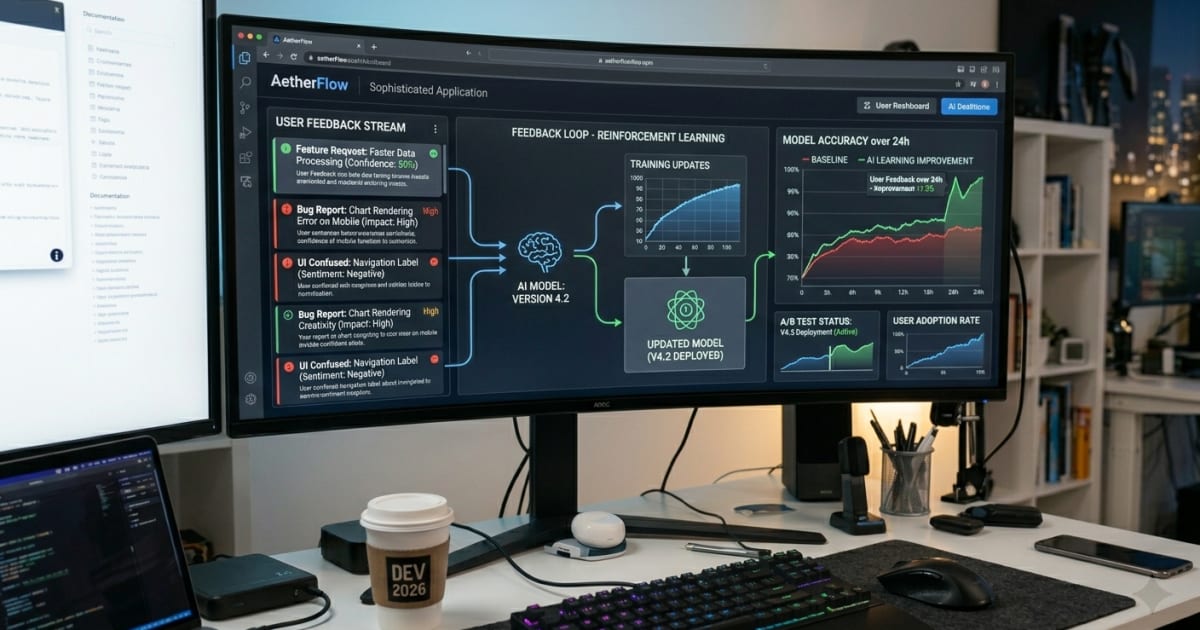
The best AI products improve from usage. Implementing feedback loops—thumbs up/down, corrections, implicit signals—turns users into trainers. Here's how to design systems that genuinely learn.
Types of User Feedback
interface FeedbackTypes {
  explicit: {
    thumbsUpDown: boolean
    starRating: number
    textCorrection: string
    reportProblem: string
  }
  implicit: {
    acceptedSuggestion: boolean
    editedOutput: boolean
    timeToAccept: number
    abandonedInteraction: boolean
    followUpQuestion: boolean
  }
}

// Explicit is clearer but rarer
// Implicit is noisier but abundant
Collecting Feedback Without Annoying Users
// Non-intrusive feedback UI
function FeedbackButtons({ responseId }) {
const [feedback, setFeedback] = useState(null)
const handleFeedback = async (value) => {
setFeedback(value)
await submitFeedback({ responseId, value })
}
return (
)
}
// Implicit signal collection
function trackImplicitFeedback(responseId: string) {
const startTime = Date.now()
return {
onCopy: () => submitImplicit(responseId, 'copy', Date.now() - startTime),
onEdit: (original, edited) => submitImplicit(responseId, 'edit', { original, edited }),
onFollowUp: (question) => submitImplicit(responseId, 'followup', question),
onAbandon: () => submitImplicit(responseId, 'abandon', Date.now() - startTime),
}
}Storing and Processing Feedback Data
interface FeedbackRecord {
  id: string
  timestamp: Date
  userId: string

  // The interaction
  prompt: string
  response: string
  model: string

  // Feedback signals
  explicit?: ExplicitFeedback
  implicit?: ImplicitSignal[]

  // Computed quality score
  qualityScore?: number
}

// Processing pipeline
class FeedbackProcessor {
  async process(record: FeedbackRecord): Promise {
    // Convert signals to quality score
    const score = this.computeScore(record)

    // Categorize issues
    const issues = await this.categorizeIssues(record)

    // Check if suitable for training
    const trainingEligible = this.checkTrainingEligibility(record)

    return { ...record, score, issues, trainingEligible }
  }

  private computeScore(record: FeedbackRecord): number {
    let score = 0.5  // Neutral default

    if (record.explicit?.thumbsUpDown !== undefined) {
      score = record.explicit.thumbsUpDown ? 0.9 : 0.1
    }

    // Adjust based on implicit signals
    if (record.implicit?.some(s => s.type === 'copy')) score += 0.1
    if (record.implicit?.some(s => s.type === 'edit')) score -= 0.2
    if (record.implicit?.some(s => s.type === 'abandon')) score -= 0.3

    return Math.max(0, Math.min(1, score))
  }
}
From Feedback to Improvement
// 1. Identify patterns in low-quality responses
async function analyzeFailurePatterns(feedbackRecords: ProcessedFeedback[]) {
  const lowQuality = feedbackRecords.filter(r => r.score < 0.3)

  // Cluster by prompt type
  const clusters = await clusterByTopic(lowQuality.map(r => r.prompt))

  // Find common issues
  const patterns = clusters.map(cluster => ({
    topic: cluster.label,
    count: cluster.items.length,
    commonIssues: analyzeIssues(cluster.items),
  }))

  return patterns.sort((a, b) => b.count - a.count)
}

// 2. Update prompts based on feedback
function generatePromptImprovements(patterns: FailurePattern[]) {
  return patterns.map(pattern => ({
    originalBehavior: pattern.commonIssues,
    suggestedPromptAddition: generateFix(pattern),
    expectedImprovement: estimateImprovement(pattern),
  }))
}

// 3. A/B test improvements
class PromptExperiment {
  async run(control: string, variant: string, traffic: number = 0.1) {
    // Route percentage of traffic to variant
    // Collect feedback for both
    // Compare quality scores
    // Graduate winner to 100%
  }
}
Privacy Considerations
interface PrivacyConfig {
  // What to collect
  collectPrompts: boolean        // Usually yes with consent
  collectResponses: boolean      // Usually yes
  collectCorrections: boolean    // Very valuable, needs consent

  // Anonymization
  anonymizeUserId: boolean       // Hash or random ID
  redactPII: boolean             // Remove emails, names, etc.

  // Retention
  retentionDays: number          // Auto-delete after period

  // User control
  allowOptOut: boolean           // Required in many jurisdictions
  allowDeletion: boolean         // GDPR/CCPA requirement
}

async function processFeedbackWithPrivacy(
  feedback: RawFeedback,
  config: PrivacyConfig
): Promise {
  if (config.redactPII) {
    feedback = await redactPII(feedback)
  }
  if (config.anonymizeUserId) {
    feedback.userId = hashUserId(feedback.userId)
  }
  return feedback
}
Key Takeaways
Implicit feedback is abundant. Track copy, edit, abandon, and follow-up signals.
Make explicit feedback frictionless. Thumbs up/down should be one click.
Close the loop. Feedback without action is waste. Build pipelines that improve the product.
Respect privacy. Anonymize, redact PII, allow opt-out, and retain data responsibly.